
Roof Replacement in Port Charlotte, FL
A new roof in Florida is built in layers, and the ones you will never see again once the job is finished do most of the work in a hurricane. This page walks through them in the order they go on.
Call (941) 401-8127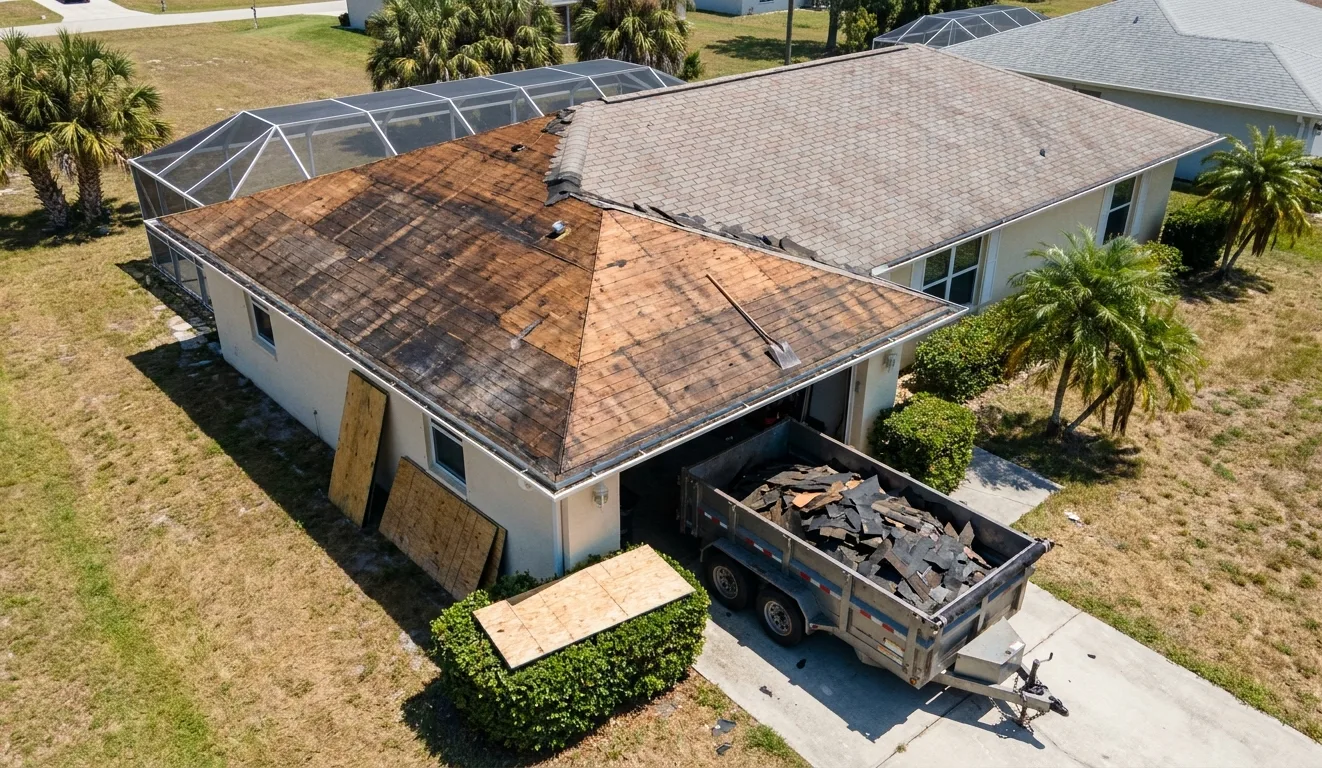
Why the old roof comes all the way off
Laying new shingles over old ones is quicker and it skips the dump fees. It also skips the only opportunity anyone will have for the next two decades to see the plywood, replace what has rotted, and fasten it the way the present code expects.
State law points the same direction. The hurricane mitigation items written into Florida's re-roofing requirements, improved deck fastening and a secondary water barrier, can only be carried out on a bare deck. So every replacement we do starts with a complete tear-off down to the sheathing.
The layers, from the trusses up
Sheathing checked and replaced where needed
With the deck exposed, each sheet is walked and probed. Soft, delaminated or blackened plywood is cut out back to the middle of a truss and replaced with matching thickness. You are shown it before it is covered.
Deck re-nailed
Houses built before the statewide code took effect in 2002 were often sheathed with staples or widely spaced smooth nails. Additional ring-shank nails are driven along every truss to the schedule the current code sets. It is noisy, and it is the single biggest gain in wind resistance in the whole job.
Deck sealed
A secondary water barrier goes over the plywood: a self-adhered membrane across the full deck, or taped sheathing joints beneath an approved underlayment. If a storm later removes the visible roof, this layer keeps rain out of the attic.
Edges and flashings
New drip edge at eaves and rakes, new valley metal, new boots at every pipe, and new flashing where the roof meets a wall or a lanai. Reusing old flashing on a new roof is a common shortcut and a common source of early leaks.
The roof covering
Shingles are fastened in the manufacturer's high-wind pattern, tile is set by the method its product approval specifies, and metal panels are clipped or screwed at the engineered spacing for the site.
Ventilation and close-out
Ridge or off-ridge vents are matched to the soffit intake so the attic can shed heat. The county's final inspection follows, and you receive the permit record along with photographs of each stage.
Shingle, tile or metal
Most owners replace like with like. A re-roof is also the moment to change, provided the structure suits the new material. Tile weighs several times what shingles do, so going from shingle to tile needs an engineer to confirm the trusses can carry it. Going the other way needs nothing structural.
| Architectural shingle | Concrete tile | Standing-seam metal | |
|---|---|---|---|
| Weight on the structure | Light | Heavy | Lightest |
| What wears out first | The shingle itself, from heat and sun | The underlayment under the tile | Sealants and trim details, long after the others |
| Behavior in high wind | Depends on sealant bond and nailing | Strong when well attached. Loose tiles become debris | Very strong when clipped to the engineered spacing |
| Repair after damage | Straightforward | Slow, and matching old profiles is difficult | Panels are replaced whole |
| Relative cost | Lowest of the three | Highest or near it | Between the two, sometimes level with tile |
If you live in a deed-restricted community, check the rules before settling on a material or a color. Some associations around Charlotte County specify tile or limit the palette, and their approval can take longer than the permit.
Permit and inspections
Re-roofs in Port Charlotte are permitted through Charlotte County Community Development. The application names the products being installed and their Florida product approval numbers, which is how the county confirms that each one has been tested for the wind speeds that apply at your address.
County inspectors see the job partway through and again at the end. The in-progress visit matters most to you, because it happens while the deck fastening and the sealed layer can still be looked at. A job that covers those up before inspection has a problem, and a careful installer plans the sequence so it never comes up.
Keep the closed permit with your house papers. It is the document an insurer, a buyer or a wind mitigation inspector will ask for when they want the age of the roof and the code it was built to.
What the days of the job are like
A shingle roof on a typical single-storey house here is commonly stripped and dried in on the first day and finished within two or three, with tile and metal taking longer. Weather can stretch that, and in summer each day's tear-off is limited to what can be sealed before the afternoon storms.
It is loud indoors, especially during re-nailing. Pictures can shake on walls, so take down anything fragile. Dust and grit will fall into the attic and the garage, and cars should be parked on the street. Pets tend to hate it.
Outside, the pool cage and lanai screens are the most vulnerable things on the property. They are covered with netting or plywood before the first shingle moves. Port Charlotte Roofing also photographs the cage, the gutters and the driveway beforehand, so there is a record of their condition that both sides can refer to.
Questions people ask us
Can a new roof go over my existing shingles?
We do not install that way. A roof replacement in Florida is supposed to include re-fastening the deck and adding a secondary water barrier, and neither can be done with the old roof still in place. A tear-off also exposes rotten sheathing that a layover would bury.
Will a new roof lower my insurance premium?
It can. Insurers in Florida take roof age, deck attachment, secondary water resistance and roof shape into account, and a re-roof improves several of those at once. A wind mitigation inspection after the work documents the features. Your agent can tell you what credits your carrier applies.
Can I switch from tile to shingle or metal?
Structurally, yes, since both are lighter than tile. Check any homeowners association rules first, and expect the look of the house to change. Switching to tile from a lighter roof is the direction that needs an engineer's review.
What happens if you find rotten wood?
It is replaced before the new roof goes on. The estimate states a rate for each sheet of plywood and each length of fascia, so the cost of any extra wood is known in advance. You are shown photographs of what was replaced.
Do I have to be home during the work?
Not for all of it. It helps if someone is reachable on the first morning, when the deck is exposed and decisions about wood replacement are made, and again for the final walk-through.