
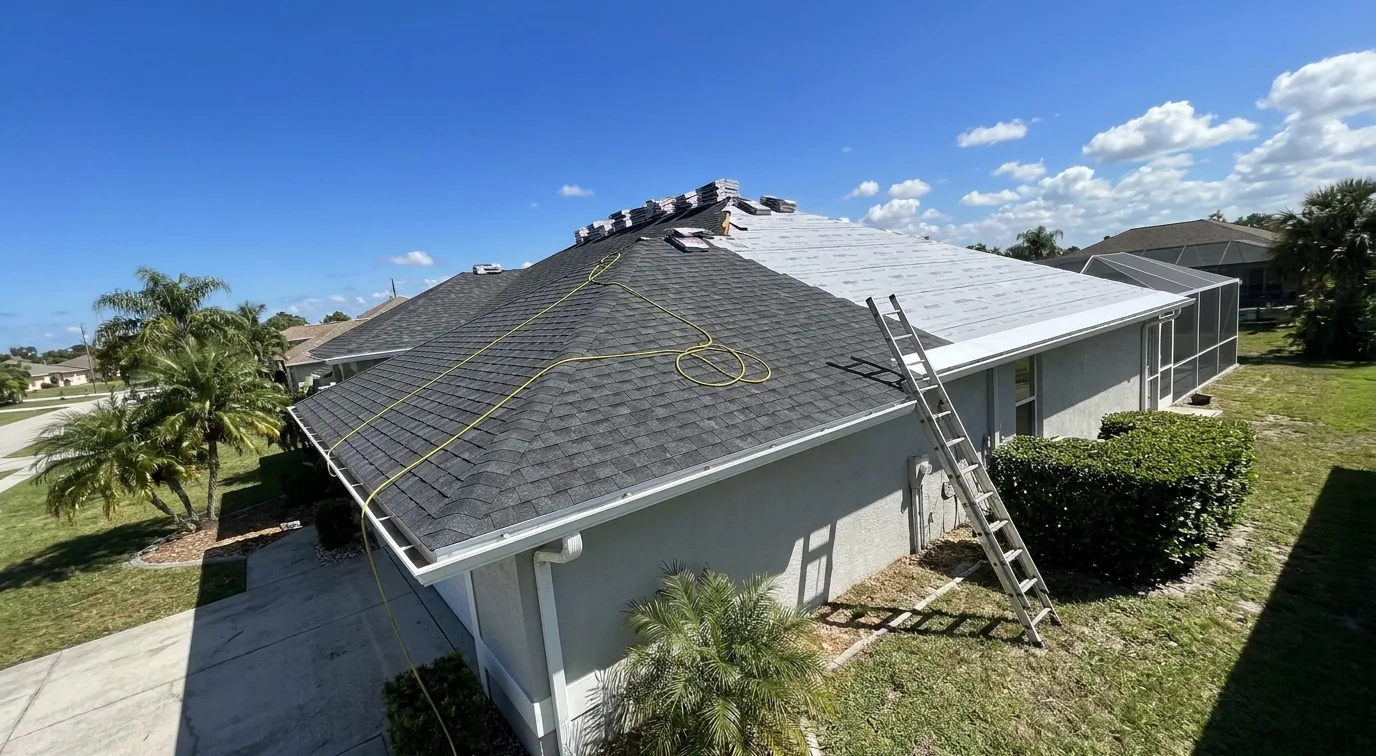
Port Charlotte & Charlotte County · Residential Roofing
Roofing in Port Charlotte, FL
A water mark spreading across the lanai ceiling. Ridge caps in the swale after a squall came up the harbor. A letter from the insurer asking how old the roof is. We repair and replace roofs across Port Charlotte, and we start by telling you which of those two your house really needs.
- Written estimates before any work
- Photos of everything we find
- Storm tarping and dry-in
- Shingle, tile and metal
- County-permitted re-roofs
Repair work we do around Port Charlotte
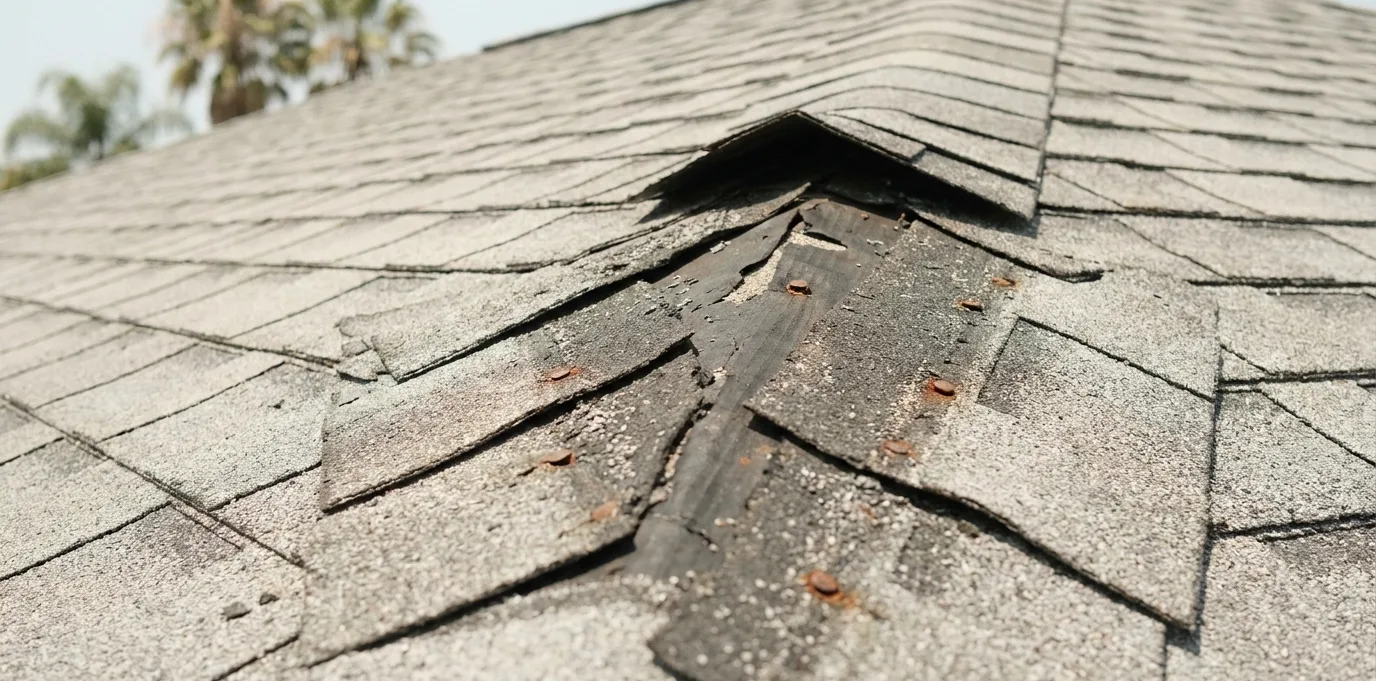
Roof Repair
The entry point found first, then the boot, flashing, valley or tile underlayment behind it rebuilt properly.
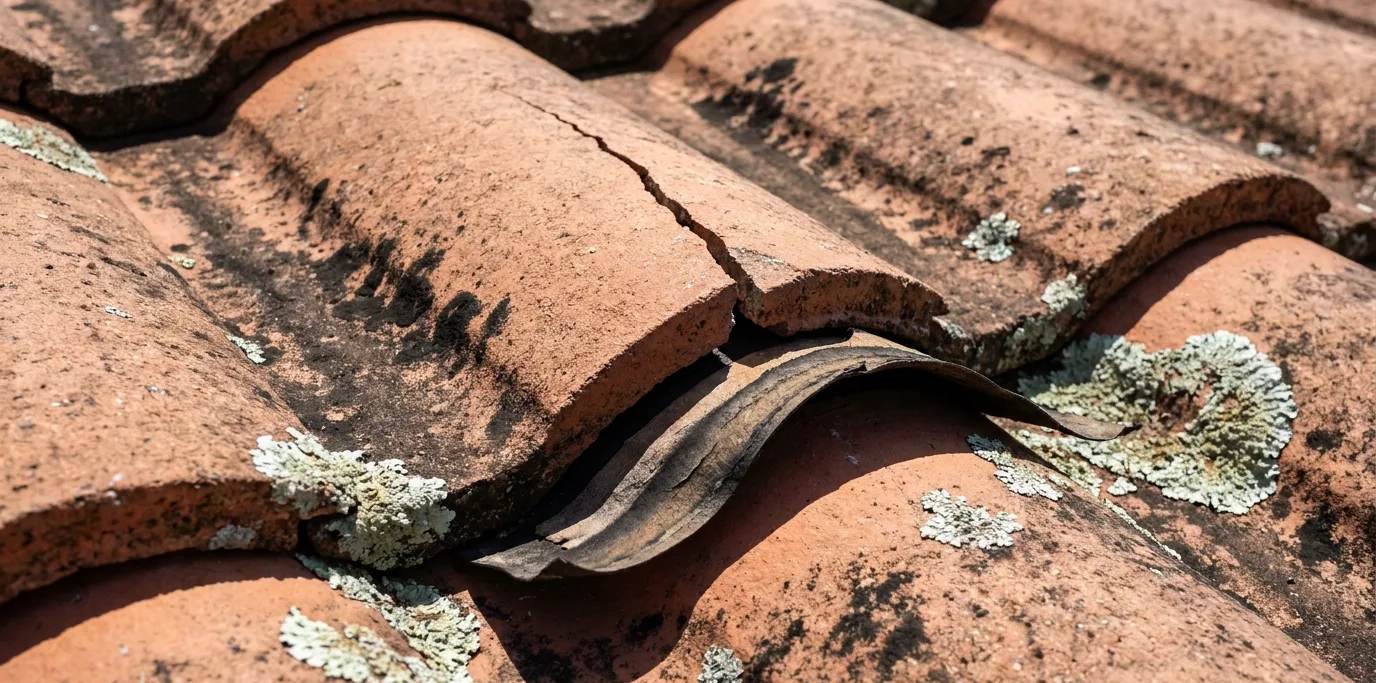
Emergency Roof Repair
Tarps fastened to hold through the next squall, wet ceilings relieved, and the lasting fix scheduled.
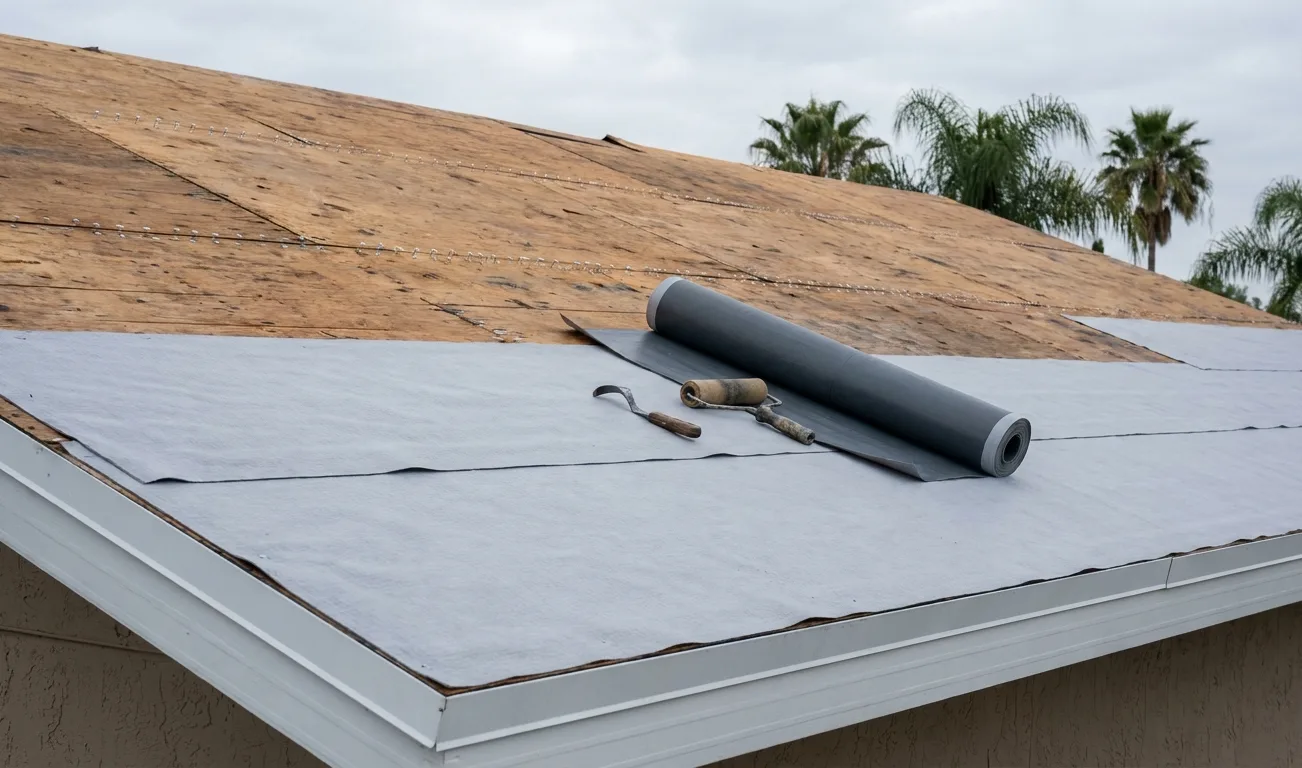
Storm Damage Roof Repair
Hurricane, tornado and squall-line damage photographed slope by slope and written into a clear scope.
Six signs a roof here is asking for attention
Roofs in Charlotte County rarely fail in one dramatic moment outside of a hurricane. Most of them announce it over a wet season or two, and the signs are easy to read once you know what each one means.
A ceiling stain that shows up in August and fades by January
Summer here means a downpour most afternoons, often pushed sideways by a gust front. A stain that follows the wet season is usually rain being driven under a flashing or a lifted shingle, and it dries out when the daily storms stop.
Tile or shingle pieces on the ground
Anything in the yard came off an edge, a hip or a ridge. Those are the highest-pressure parts of a roof in wind, and a missing piece there leaves its neighbors with nothing holding them down the next time it blows.
Black streaks down the north and east slopes
That is algae feeding on the limestone filler in the shingle, and in this humidity nearly every roof gets it. It is ugly and it runs the attic a little hotter. It is not a reason to replace anything.
Soffit panels sagging or missing under the eave
Vented aluminum and vinyl soffit is the first thing strong wind pulls loose. With it gone, rain blows straight into the attic over the top of the wall, and the ceiling stain that follows gets blamed on the roof.
A gray pipe on the roof with a ragged top
Plumbing vents on Florida houses are often flashed in soft lead, and squirrels chew it. A boot gnawed down below the top of the pipe lets rain run down the outside of the vent and into the bathroom wall.
Bare, shiny or blistered patches on the shingles
Fifteen summers of ultraviolet and attic heat cook the oils out of asphalt. The granules let go, the mat shows through, and from then on the roof ages a little faster every year.
What is on the houses in Port Charlotte
Most of this community was platted by one developer from the late 1950s onward and filled in over the following decades, so the housing is consistent: single-storey concrete block, a low hip roof, a lanai under the main roofline or a flatter one tacked on behind. Four kinds of roof cover nearly all of it, and each wears out in its own way.
- Asphalt shingles are on the majority of homes in the older sections and around Murdock. Heat is what ends them here. Expect a shorter working life than the same product gets up north, with the south and west slopes going first.
- Concrete tile is common in Deep Creek, Rotonda West and the newer canal-front streets. The tile can outlast the house. The underlayment beneath it cannot, and when a tile roof of twenty-five years or more starts leaking in several rooms, that hidden layer is nearly always why.
- Metal went onto a lot of roofs after Hurricane Charley in 2004 and again after Ian in 2022. Standing seam holds up very well. Older screw-down panels need their fasteners and washers looked at, because those age faster than the steel.
- Flat and low-slope sections sit over lanais, carports and additions. They are membrane roofs, they depend on drainage, and they are responsible for more leak calls per square foot than anything else we work on.
Knowing which one you have matters before anybody quotes anything. A repair that is right for a shingle roof is wrong for tile, and a company that only installs one material tends to find that every roof needs that material.
What the storm record says about Charlotte County
People new to the area ask about hail, because that is what wrecks roofs where they moved from. The public record points somewhere else. NOAA maintains a national storm events database holding an entry for every significant event a forecast office documents, and we pulled every Charlotte County entry for the ten years from 2015 through 2024.
| Event type | Entries | Worth knowing |
|---|---|---|
| Hail | 2 | The larger of the two was one inch across, near Charlotte Harbor on August 5, 2022. Hail is close to a non-event for roofs here. |
| Tornado | 15 | None rated above EF1. Several began as waterspouts that came ashore, and three touched down on the day Hurricane Milton passed in October 2024. |
| Thunderstorm wind | 19 | The highest estimate was 63 knots, about 72 mph, at Englewood on December 21, 2021. |
| Tropical storm | 14 | Zone entries from Colin and Hermine in 2016 through Idalia in 2023 and Debby in 2024. Idalia, passing well offshore, still produced a 61 mph gust near Charlotte Harbor. |
| Hurricane | 3 storms | Irma in 2017, Ian in 2022 and Milton in 2024. The highest gust reported in the county during Ian was 111 mph, near Grove City, on September 28, 2022. |
Source: NOAA National Centers for Environmental Information, Storm Events Database, annual detail files for 2015 to 2024, filtered to Florida and to the Charlotte county and forecast-zone names. Counts are database entries, and a single storm can produce more than one.
The pattern is wind, from several directions and in several sizes: the hurricane every few years, the tropical storm in most years, and short-lived tornadoes that never make the national news. The one that came through the Charlotte Harbor area on February 24, 2016 was rated EF1, and the survey notes record 108 homes affected, most of them with damage to roofs and pool cages. That is an ordinary winter weekday, months outside hurricane season.
It is the reason roofs here are judged on how they are fastened and sealed at the edges, and far less on the impact rating printed on the wrapper.
How a job with us goes
A phone call that gets the basics
Call (941) 401-8127. We will ask what the roof is made of, roughly when it was last replaced, where the problem shows inside the house and what the weather was doing when you first noticed it.
A visit that includes the attic
Somebody walks the roof where the material allows it. Tile gets walked carefully or inspected from a ladder and from above. Then we look at the underside of the deck from inside, because that is where a leak leaves its trail.
Pictures before opinions
You are shown photographs of each thing we found, with the slope and location noted. If the roof has years left in it, the pictures will show that too.
An estimate on paper
The scope, the materials by name, what happens if rotten decking turns up, and what is excluded. For a re-roof it also covers the Charlotte County permit and the inspections that come with it.
The work, then the cleanup
Pool cages, AC condensers and plantings are covered before tear-off starts. Debris goes into a trailer as it comes off, and a magnet sweep covers the lawn, the drive and the pool deck before we call it finished.
What Florida law requires when a roof is replaced
A re-roof in this state is a regulated event, and it is worth knowing the outline before you compare estimates. Port Charlotte is unincorporated, so the permit comes from Charlotte County, which reviews roofing under the Florida Building Code.
Section 553.844 of the Florida Statutes sets out the hurricane mitigation work that has to be folded into a roof replacement on a site-built single-family house. It names two items for every such re-roof: a secondary water barrier, and strengthening or correcting the roof-decking attachments and fasteners. In practice that means the plywood is re-nailed to current spacing while it is exposed, and the deck is sealed so it sheds water by itself.
The same section adds a third item for homes in the wind-borne debris region with an insured value of $300,000 or more: improving the roof-to-wall connections, with the cost of that work limited to approximately 15 percent of the cost of the re-roof.
It also settles an argument that used to come up after every storm. Under subsection (5), when a roof that was built or replaced in compliance with the 2007 Florida Building Code or a later edition has 25 percent or more of a section repaired, only the repaired portion has to be brought to current code. A newer roof with one damaged slope does not automatically become a whole new roof.
One local detail from the county's own permit guidance: wind exposure for a house is taken as Category C unless it stands within 600 feet of a major body of water, where the more demanding Category D applies. With the harbor, two rivers and a long network of canals, that distinction affects more addresses here than in most places, and it changes the fastening an installer has to use.
What decides the cost of a roof
No figure appears on this page because a figure given without seeing the roof is a guess. These are the things that move the number, and they apply to any estimate you are handed, ours included:
- The material coming off. Shingles strip quickly. Concrete tile is heavy, slow to remove and costly to haul, and a mortar-set ridge takes longer again.
- The material going on. Architectural shingle, concrete tile and standing-seam metal sit at three different levels of cost and of expected service life.
- Shape. Hip roofs have more cut pieces and more linear feet of hip and ridge than a plain gable. Valleys, dormers and dead valleys behind a lanai add labor.
- Deck condition. Nobody can see it until the old roof is off. Rotten sheathing gets replaced, so the estimate should state a rate per sheet up front.
- Everything attached. Skylights, solar panels, a pool cage that ties into the fascia, and gutters all have to be worked around, removed or reset.
Ask each company to list those five items separately. Estimates become much easier to compare when they are broken out the same way.
Re-roofs, inspections and metal
Roof Replacement
Stripped to the deck, re-nailed, sealed against wind-driven rain and finished in shingle, tile or metal.
Roof Inspection
Roof surface and attic checked together, with a dated photo report you can hand to a buyer or an insurer.
Metal Roofing
Standing seam and screw-down panels, with the alloy and coating chosen for how close you are to salt water.
Towns and neighborhoods we get to
- Port Charlotte
- Punta Gorda
- North Port
- Charlotte Harbor
- Deep Creek
- Murdock
- Harbour Heights
- El Jobean
- Gulf Cove
- Englewood
- Rotonda West
- Lake Suzy
Questions people ask us
How long does a shingle roof last in Port Charlotte?
Shorter than the rating on the wrapper suggests. Heat and ultraviolet light age asphalt faster here than in cooler states, and many shingle roofs in Southwest Florida are worn by their late teens. Attic ventilation, roof color and the quality of the installation all change that number, so two houses on one street can differ by years.
Do I need a permit to replace my roof?
Yes. A re-roof in unincorporated Charlotte County needs a county permit, and inspections are part of it. The roofing company applies for it as part of the job. Small repairs are treated differently, and we will tell you which side of the line your work falls on.
My insurer says my roof is too old. What can I do?
Florida law addresses this directly. Under section 627.7011 an insurer may not refuse to issue or renew a homeowner policy solely because a roof is under 15 years old, and for a roof 15 years or older the owner must be allowed to have it inspected. If an authorized inspector finds five or more years of useful life, age alone cannot be the reason. Ask your insurer who qualifies as an authorized inspector for that purpose.
Is tile better than shingle in a hurricane?
Neither wins automatically. A well-fastened tile roof resists wind well, but loose tiles become heavy debris and repairs cost more. A shingle roof installed to current code with a sealed deck beneath it protects the house even if shingles are lost. How the roof is attached matters more than what it is made of.
Can you work on a roof with solar panels?
Yes, but the panels have to come off for a re-roof and go back on afterward, and that is normally done by the solar company so their warranty stays intact. Tell us about panels on the first call so the two schedules can be lined up.
When is the best time of year to re-roof?
The dry season, roughly November through April, gives the longest runs of clear days. Roofs are replaced all year here, though. In summer the work is staged so that nothing is left open when the afternoon storms build.